
Bitcoin's 10-minute blocks are a feature, not a bug—they're what make it the most secure blockchain in existence. But they also make Bitcoin too slow for many use cases. Kontor is the first metaprotocol to transcend these limits, without sacrificing any security. Using a novel protocol for optimistic consensus and a variety of cutting-edge optimizations to transaction encoding, Kontor is able to achieve 1–2 second confirmations and over 1,000 TPS, all while relying entirely on Bitcoin for finality. And in the process, Kontor reduces effective fee rates by over 100x. Previous efforts to increase the scalability of Bitcoin transactions have involved moving transactions off-chain with sidechains or rollups, abandoning Bitcoin’s whole trust model and introducing huge amounts of complexity. But it turns out that with some clever engineering and cryptoeconomics, we can scale the Bitcoin blockchain just by building directly on top of it.
On-Chain vs. Off-Chain Scaling
Every Kontor transaction is simply extra data stored inside a regular Bitcoin transaction. Kontor indexers scan Bitcoin blocks, find Kontor transactions, and execute them according to the Kontor protocol rules. Because Bitcoin provides an immutable log and Kontor's rules are deterministic, every indexer arrives at the same state. This is called embedded consensus. Kontor’s approach inherits Bitcoin's security guarantees: if Bitcoin is secure, Kontor is secure.
For a long time, it has been a clear assumption of the blockchain industry’s that in order to scale Bitcoin transactions it would be necessary to use a Layer-2 network such as Lightning, sidechains, or zk-rollups. But it turns out it’s not necessary—much less desirable—to abandon the Bitcoin blockchain in order to improve latency and throughput.
Naively, any metaprotocol is fundamentally constrained by the limits of the underlying consensus system—in this case, 4 million weight units per block, one block every ten minutes, and roughly 10 transactions per second. Other metaprotocols, including Counterparty, Ordinals, Stamps, Alkanes, etc. are all only as fast as Bitcoin itself. Kontor is the first metaprotocol that has been able to work around these limitations, without changing the security model, using two major innovations: optimistic consensus and aggressive optimization of transaction encoding.
Optimistic Consensus: 1–2 Second Confirmations
Here's an important observation: stateful metaprotocols have an extra degree of freedom that Nakamoto consensus leaves unspecified—the ordering of transactions within a single Bitcoin block. Two transactions that modify the same contract state produce different results depending on which executes first. Since all transactions in a block appear to the network simultaneously, this ordering must be resolved by some rule, but the choice of rule is up to the metaprotocol.
Kontor exploits this freedom. Rather than waiting for Bitcoin confirmation to determine ordering, a network of KOR stakers runs BFT consensus to produce signed transaction batches that assign deterministic positions before Bitcoin confirmation. Users can transact with confidence after batch inclusion—typically within 1–2 seconds—because the ordering is already fixed.
A Virtual Prediction Market
When stakers sign a batch, they're participating in a virtual prediction market. Each signature is a prediction backed by slashable collateral: "these transactions will confirm on Bitcoin without conflict before this batch expires." The staker is betting their capital on this outcome.
If the prediction holds—the batched transactions confirm normally on Bitcoin—stakers earn fees and protocol emissions. If the prediction fails—a conflicting transaction confirms on Bitcoin instead—the batched transactions are rolled back and stakers are slashed.
This creates economic finality, just like what Bitcoin itself offers. When a quorum (>2/3 of total stake) signs a batch, the transaction has economic finality proportional to the total stake at risk. Recipients can calibrate their acceptance threshold based on transaction value—small payments may accept minimal stake backing, while large transfers may require the full quorum.
Unlike vague "zero-confirmation" signals, optimistic consensus makes the remaining risk explicit and quantifiable. The stake backing each batch is public. The slashing conditions are deterministic. Recipients know exactly what is at risk and can make informed decisions. And if stakers fail to reach consensus, or if the staker network goes offline entirely, transactions still confirm on Bitcoin normally. The staker layer accelerates finality but never blocks it; optimistic consensus builds directly on top of Nakamoto consensus and never replaces it.
Scalability: 1,000+ TPS and 100× Lower Fees
Fast confirmations solve the latency problem, but Bitcoin's block size still limits throughput. Other metaprotocols top out around 10 transactions per second, just like Bitcoin itself. But Kontor reaches over 1,000 TPS through aggressive optimization of per-transaction payload size.
BLS Signature Aggregation
The most significant optimization is trustless BLS signature aggregation. Vanilla Bitcoin signatures require one 64-byte Schnorr signature per input, and these cannot be aggregated across different keys. BLS signatures can be aggregated: N signatures from N different signers compress into a single 48-byte aggregate signature. Users sign their Kontor operations using a BLS key derived from their seed phrase. Bundlers—infrastructure providers who collect signed operations from users—combine all signatures into a single aggregate, construct a Bitcoin transaction containing all operations, and broadcast it to the network. Users don't need to trust bundlers. The BLS signature scheme has a key property: given signed operations, anyone can produce a valid aggregate. Bundlers can't forge, modify, or censor individual operations—they can only include them or not.
Registry IDs
Kontor maintains a deterministic registry that maps long identifiers (public keys, contract addresses) to compact 4-byte numeric IDs. When a new identifier first appears, the indexer assigns it the next sequential ID. This is deterministic—all indexers processing the same blocks assign the same IDs. The result: 4 bytes instead of 32+ bytes per identifier, an 8–16× reduction in identifier overhead.
Binary Encoding + Compression
Operations are encoded in a compact binary format that removes syntactic overhead. The final layer is Zstd compression, which exploits redundancy across batches: repeated contract IDs, common function indices, and similar argument patterns.
The Numbers
The combined effect is dramatic:
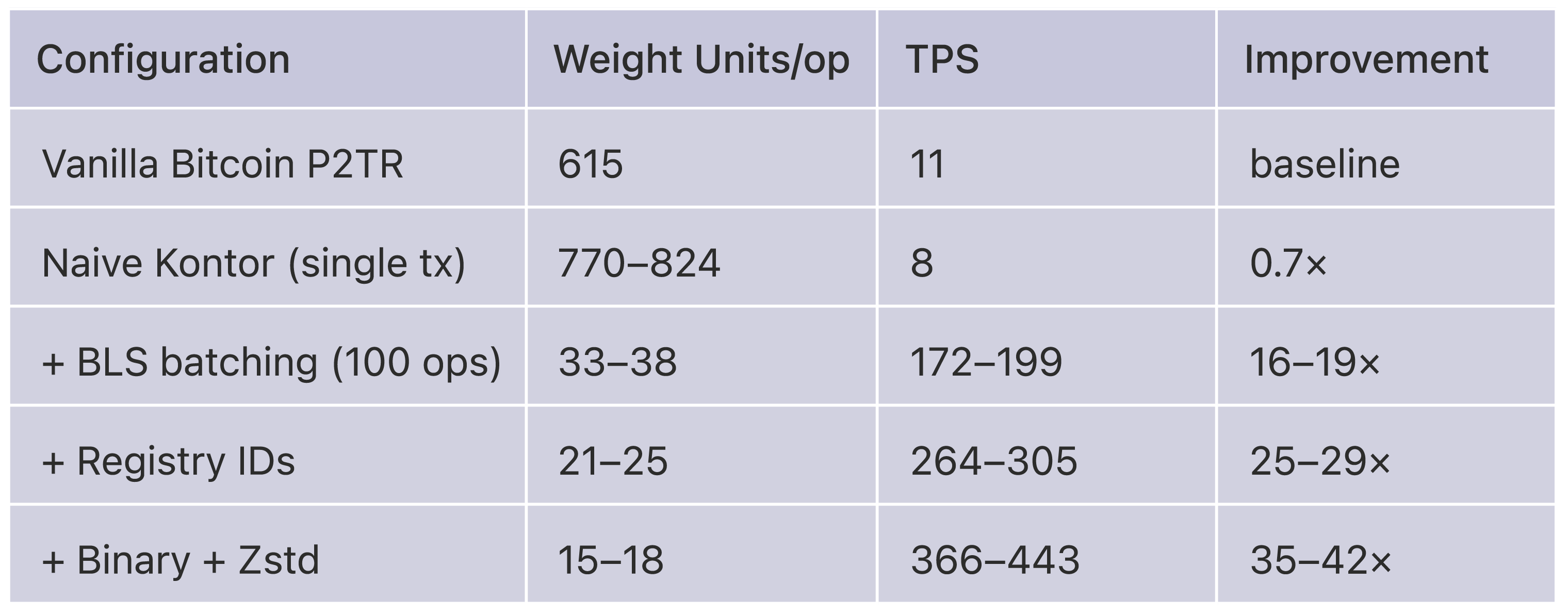
At batch sizes of 1,000–10,000 operations, Kontor achieves 5–10 weight units per operation, supporting 700–1,300 TPS. That's over 100× more efficient than vanilla Bitcoin transactions.
Because Bitcoin fees are denominated in satoshis per weight unit, these efficiency gains also translate directly into cost savings. A Kontor operation in a large batch costs roughly 1/100th the fee of an equivalent vanilla Bitcoin transaction. High throughput and low cost go hand in hand.
Conclusion
Kontor proves that Bitcoin's limitations are not fundamental—they're implementation choices that can be transcended without compromising security. By exploiting the ordering freedom inherent in metaprotocol design, Kontor provides 1–2 second confirmations with explicit economic finality. By aggressively optimizing payload size, it achieves over 1,000 transactions per second on unmodified Bitcoin, with commensurate improvements in transaction fees as well.
All of this happens entirely on Bitcoin. Every Kontor transaction is just data inside of a Bitcoin transaction. The ten-minute blocks remain, as strong as ever—Kontor users just no longer need to wait for them.
Read the full technical specifications: Optimistic Consensus | Scalability
